FRAGMENTAL ART MANIFESTO
Manifesto of Fragmental Art.
Fragmental painting arises from a fundamental question: what, in the 21st century, still remains to be transformed in our relationship to the artwork?
In a world defined by constant movement, interaction, and transformation, where nothing is fixed, why should the artwork, and painting in particular, remain immutable?
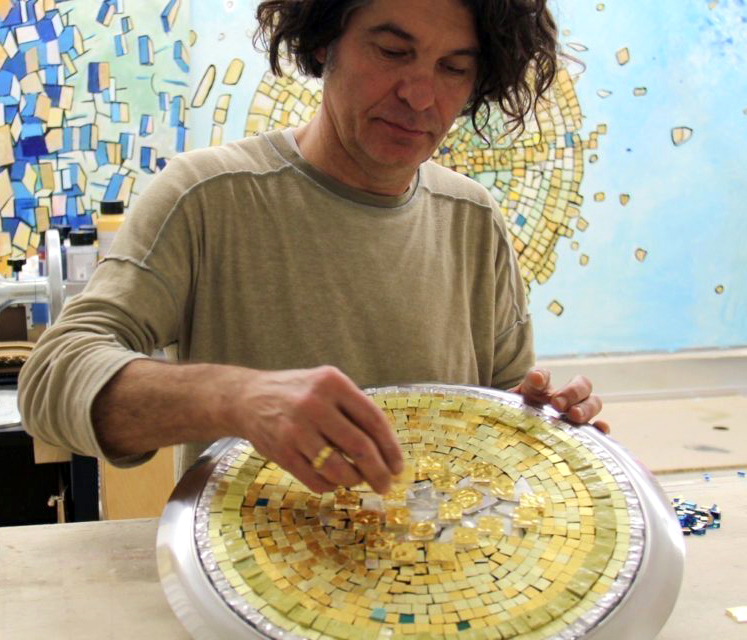
Fragmental Art was born from the encounter between two artistic universes: that of Xavier Llongueras, a polymorphous artist and inventor of magnetic mosaic, and that of Patrice Palacio, a painter who has long been fragmenting and pixelating pictorial surfaces, transforming them into achromatic screens.
From this collision emerges an autonomous form of creation. Mosaic, painting, fundamental forces, relational dynamics, and the pixel converge around a shared core: the fragment.
Fragmental Art forms a bridge between the modern and the contemporary. We are post.
Rooted in Cubism—where one painted not what was seen but what was known—fragmental painting reveals the very process through which reality manifests itself. The image is continuously deconstructed and reconstructed by the viewer.
This art makes visible the underlying grid, the structural weave from which material reality is composed. Artist and viewer become inseparable, equally immersed in this field of forces.
Unity exists both at the center and at the threshold. Each fragment contributes to the whole while simultaneously questioning its limits. Space and time collapse and are activated together.
For the first time, the viewer may act directly upon the artwork—altering its geometry, appearance, form, and expression. The artwork becomes malleable, tactile, and alive. Through intervention, it embodies the power of concrete abstraction.
Fragmental painting asserts a playful freedom. No adhesive binds fragment to support; coherence arises from a natural force, magnetism, one of the four fundamental forces of the universe.
The notion of the support itself is radically challenged. Image and painting may be assembled or disassembled across horizontal, vertical, or inclined planes simultaneously. The frame disappears. The viewer, in turn, becomes a fragment, feeding the image until it re-emerges, miraculously coherent and intelligible.
Ultimately, Fragmental Art seeks to question reality itself—to allow, through the void between fragments, a glimpse of naked Truth. The universe is composed of fragments. Fragmental Art is universal.
Like the atom and its electrons, where fundamental emptiness gives rise to all things, everything is void and attraction, void and image. Fragmental Art is an art of fracture, interstice, and emergence.
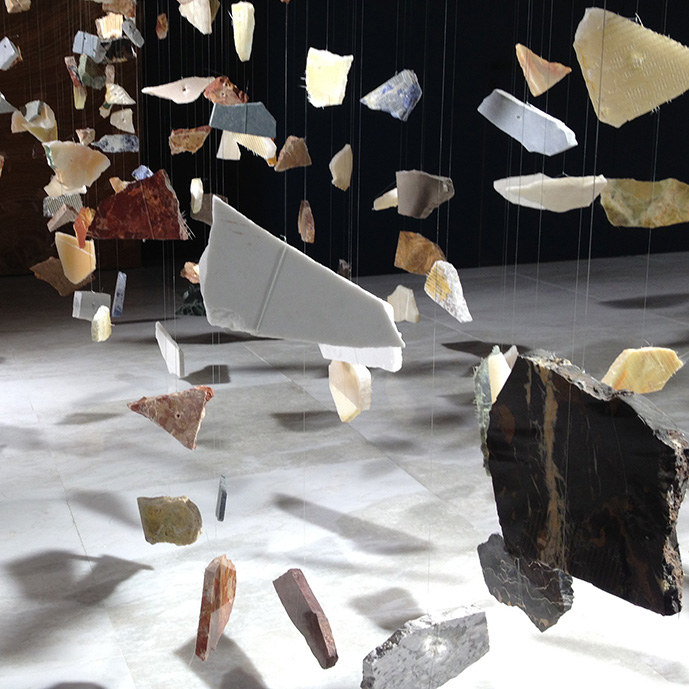
Extending beyond painting, it transforms sculpture, photography, and music. Nothing lies outside it, for fragmentation has always been the language of Nature and the condition of being human. We think in fragments; our lives are composed of fragments of sensation and memory.
The world itself is an immense constellation of fragments that generate meaning.
Llongueras & Palacio